
Beyond Automation: How Agentic AI Is Reshaping Banking
Oct 12, 2025
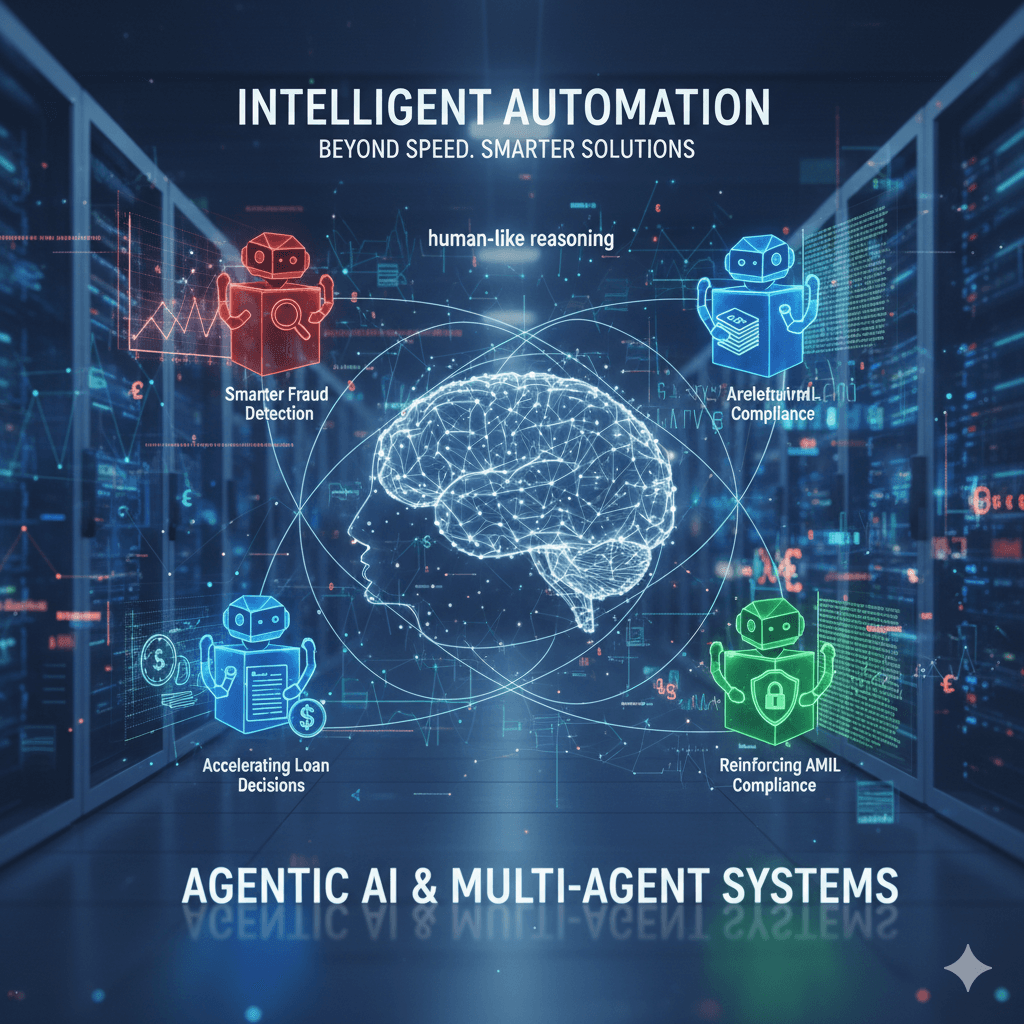
The conventional wisdom about business automation is starting to show its cracks. For years, the goal was simple: make processes faster. But speed alone doesn't solve complexity. The financial industry is now turning to a more intelligent approach—agentic AI and multi-agent systems—to not just accelerate tasks, but to manage them with human-like reasoning.
This isn't about replacing people. It’s about creating teams of specialized AI agents that collaborate to solve complex problems in real-time. From fraud detection to loan processing, these systems are already delivering results.
Smarter Fraud Detection, Real-Time Protection
Financial fraud moves fast. Traditional systems that review transactions after the fact are often too slow to prevent losses. This is where the theoretical meets the practical with multi-agent systems.
Instead of one model looking at one data point, imagine a team of AI agents working together. One agent monitors transaction patterns, another analyzes user location data, and a third cross-references historical behavior. If any agent flags a risk, they instantly communicate to collectively assess the threat. This use of multi-agent systems for fraud detection allows banks to act predictively, not reactively.
For example, Lloyds Bank has used AI's predictive power to significantly reduce fraud, protecting their customers and their bottom line. By identifying suspicious patterns before a transaction completes, they stop criminals in their tracks.
Accelerating Credit and Loan Decisions
The loan application process has long been a source of friction for both banks and borrowers. It’s slow, paper-heavy, and requires significant manual review. AI-driven loan processing automation is changing this completely.
Fintech firms like Nurix AI now offer systems that automate the entire loan lifecycle. An AI agent can receive an application, verify identity documents, run a credit check, and assess risk—all within minutes. In more complex cases, a multi-agent system can divide the work, with different agents evaluating collateral, market risk, and borrower history simultaneously to deliver a fast and accurate decision.
Reinforcing AML and Regulatory Compliance
Anti-Money Laundering (AML) compliance is a massive operational burden for financial institutions. Analysts spend thousands of hours sorting through alerts, with most turning out to be false positives. AI-powered AML compliance solutions are a direct response to this inefficiency.
Major banks, including JPMorgan, Citi, and Wells Fargo, have adopted AI to automate routine compliance tasks [link to source]. AI agents can handle sanctions alert adjudication and help draft Suspicious Activity Reports (SARs), drastically cutting down on false positives. This frees up human experts to focus on the genuinely high-risk cases that require their judgment. The subtle detail that changes the entire equation is the AI's ability to learn from past decisions, becoming more accurate over time.
The Proof Is in the Productivity
This isn't just theory; this is from the front lines of finance. The move toward agentic AI in financial services automation is backed by clear business outcomes.
Authoritative reports confirm the trend. Research from Deloitte highlights how intelligent automation drives major productivity gains in banking operations. Similarly, an IBM study notes that AI provides a clear path to cost savings and improved risk management. These systems aren't just a technological curiosity; they are becoming a competitive necessity.
The core principle to carry forward is that agentic AI enables a more resilient, efficient, and secure financial ecosystem. It helps banks move from simply processing data to understanding it.
Is your financial institution ready to move beyond basic automation? Let's discuss how multi-agent systems can address your specific operational challenges.